'Looking Glass World' — Gold, Oil and Cold Wax
Updated: Jun 12
The Fenlands of Britain exist in an imaginary space — out of time and out of step with an increasingly homogenised and utilitarian world.
They are made up of woodlands, wet grasslands, marsh, bogs, meadows, and shallow ponds, teeming with life. There is a constant visual interplay between grasses, reeds, and water; between bramble, branches, and sky. Slow-moving rivers, lodes, and streams are seen through a tracery of golden arches and erratic parabolas. A rhythmic dance of crescent-like shapes weaves an intricate latticework against deep blue skies. As winter ends, a collective movement towards the light signals regeneration — a new-found optimism, a barely concealed delight.

Materials and Technique
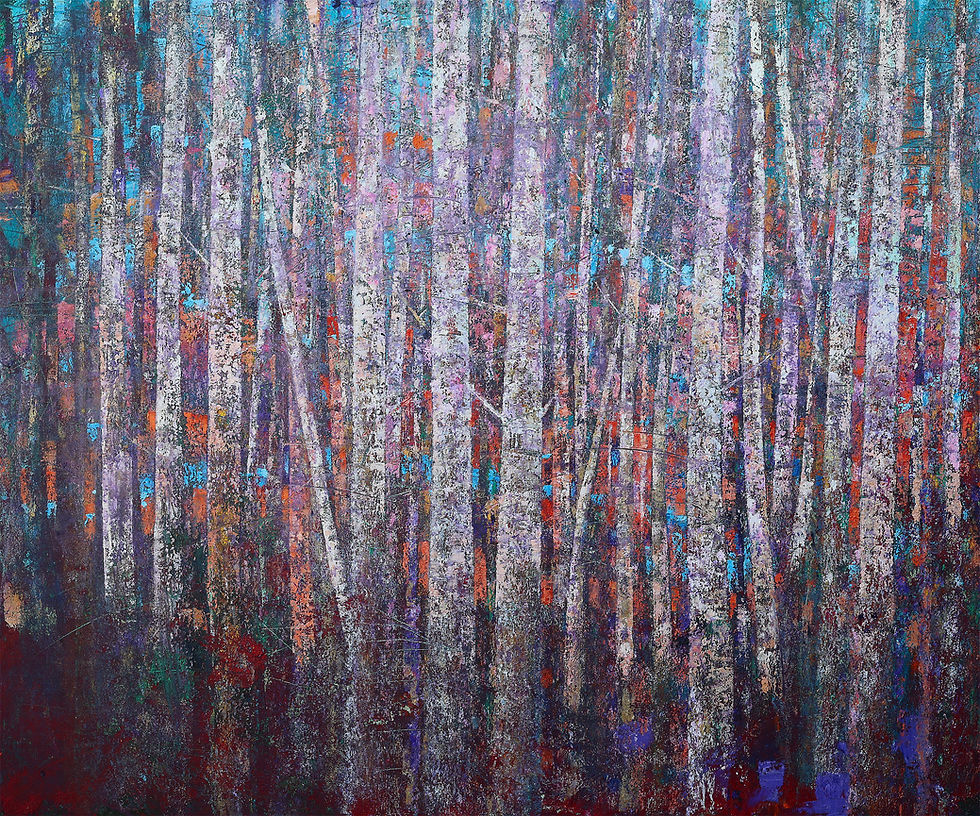
This is an oil painting with cold wax medium and assorted enamels, dyes, and pigments. The first layers of translucent colour are applied with a brayer and allowed to dry. Subsequent layers are finely textured with crumpled cellophane — a material that introduces an unpredictable, organic surface quality.
Gold enamel is trailed, poured, printed, and spattered onto the surface. The viscosity is adjusted to change the rate of flow. Within the constraints of gravity, unconventional tools — knives, forks, spoons — offer alternative trajectories, recreating the illusion of falling. The process is as much choreographic as it is painterly.

Painting and Time
It has been said many times that of all the arts, painting is ultimately about time. One reading is that a painting represents time frozen — arrested and fixed. Paintings, kinetic art excepted, do not move or change to any noticeable degree. But an equally valid argument holds that a painting is not static at all: that it embodies time in the accumulation of events, in the patient building of surfaces, in the endless adjustments, modifications, and corrections; in the life experiences and intentions of the artist, in the weeks and months of creation, in the judgements and decisions, ideas and influences that shape every mark.
The final painting is a point chosen by the artist — the moment when he or she decides it is complete, knowing that it is never really complete or final. In our looking-glass worlds, we bring our history, perception, ideas, knowledge, and preconceptions. Everything is seen through the prism of experience.



Comments