The Inescapable Picture Plane — Illusionism and the Paradox at the Heart of Painting
There is a paradox at the heart of painting that I have never been able to resolve; in fact, I believe it cannot be resolved, only experienced. Every painting I make is, in a way, a negotiation with a ghost: the ghost of the Renaissance window.
The Window We Cannot Close
In 1435, Leon Battista Alberti described the picture plane as a 'finestra aperta' — an open window through which the viewer looks into a constructed world. Although this was initially a metaphor, it evolved into a powerful concept: a perceptual habit so deeply ingrained in Western visual culture that it persists even in paintings that explicitly reject it.
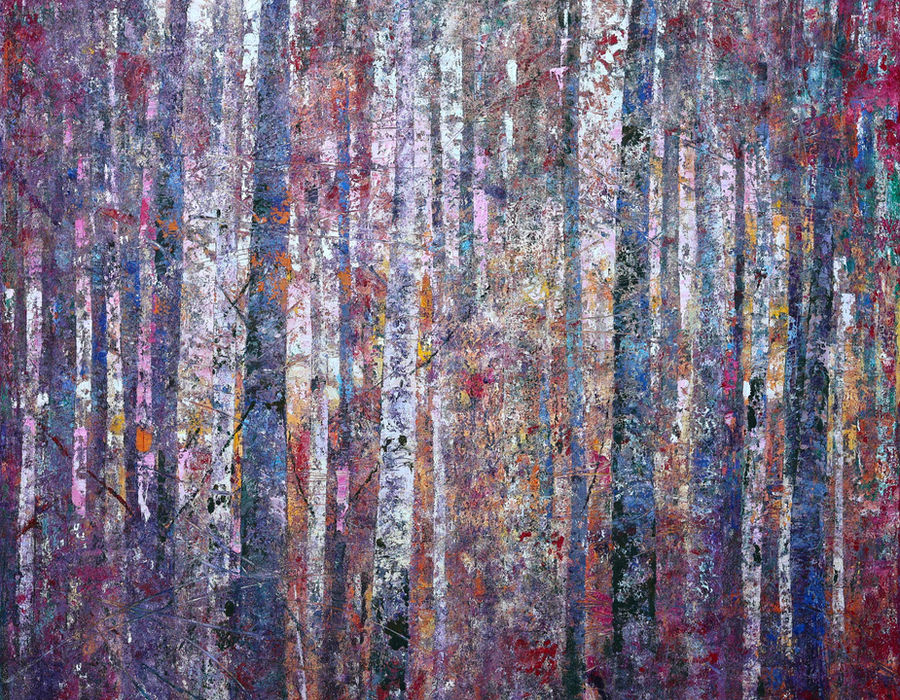
I reflect on this constantly in my own work. I create landscapes — or rather, I paint from the experience of landscapes — using oil and cold wax applied with palette knives. The surface I create is distinctly physical: layered, scraped, built up, and cut back. There is nothing illusionistic about the act of making. And yet, when I step back and look at what I have made, the eye finds its horizon, its depth, its spatial logic. The window opens, unbidden.

The Abstract Challenge and Its Limits
The major project of twentieth-century abstraction was largely an effort to eliminate depth in painting. Malevich's Black Square (1915) represents this declaration of zero: it lacks depth, narrative, and any reference to the visible world. However, there is a paradox that cannot be ignored — the black square still reads as a figure against a ground. The eye cannot help itself.
Rothko understood this, I believe, more profoundly than most. His colour fields do not deny recession; they exploit it. The soft, luminous edges of his rectangles create a spatial depth that feels almost architectural. One does not merely look at a Rothko — one is drawn into it, as if through a threshold.
Clement Greenberg argued that the defining ambition of modernist painting was to assert flatness — to acknowledge the literal, physical surface of the canvas as the only honest foundation for painting. Yet even within Greenberg's critical framework, a paradox lingers: the more a painting insists on its own flatness, the more the eye searches for depth within it.

The Body in Front of the Painting
In the late 1960s, Michael Fried identified an important distinction between paintings that fully absorb the viewer and those that merely acknowledge their presence. For Fried, the best paintings create a self-contained world that does not require the viewer's physical presence to complete it — they are, in his term, 'presentness' itself.
We cannot escape our own perceptual conditioning. The representational principles established during the Renaissance are not a style that can simply be disregarded; they form a fundamental structure of perception that has been internalised over centuries. This is how Western viewers have learned to see — and unlearning it, even partially, is the work of a lifetime.

Working Within the Paradox
My response to this paradox is not to resist it but to work within it — honestly, I hope. I choose landscape as my subject precisely because it acknowledges the remnants of representation. I am not claiming that my paintings are purely abstract, free of any reference to the visible world. They are not. But neither are they straightforward depictions. They occupy the space between — and it is in that space that I find the most productive tension.
The cold wax and palette knife create an undeniably tangible surface — thick, layered, and resistant to easy interpretation. The marks do not simply describe; they accumulate. Yet the eye, trained by centuries of pictorial convention, will find its horizon, its depth, its spatial logic. I cannot prevent this, and I no longer wish to.
The Ghost and the Wall
I have come to believe that the most honest painting embodies both elements simultaneously: the presence of the window and the reality of the wall. It acknowledges the achievements of the Renaissance without being enslaved to them. It recognises that abstraction has not liberated us from the obligations of representation — only complicated them in ways that are, ultimately, more interesting.
This paradox cannot be fully resolved, but it can be made productive — and for me, that is enough.


Comments