Forest Paintings, Ambient Music, and the Space Between
Updated: Sep 11
As a longtime musician, music has been crucial to my creativity. Recently, my focus shifted to painting, and over the past five years, I've deeply engaged in ambient music. What started as an alternative outlet has grown in importance. I've found many parallels between creating ambient music and painting, despite using different materials: paint and sound.

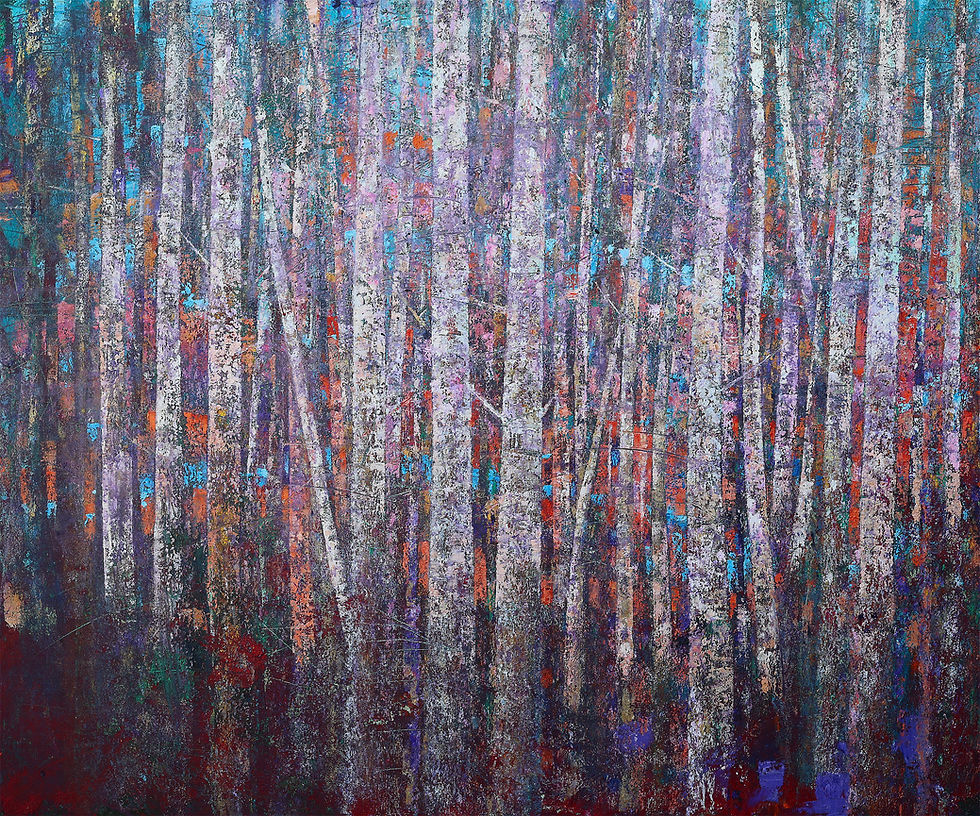
This October, I will present my forest paintings with DNG Contemporary Art at the Affordable Art Fair Battersea Autumn 2026. These works reflect my interest in light, rhythm, texture, and space, concepts deepened by my exploration of ambient music.
My forest paintings start with the act of looking. I am captivated by how light interacts with tree trunks and branches, creating shifting shadows and illumination. The forest transforms from individual trees into a network of lines, curves, and overlapping shapes. Rhythm is present in the repetition of trunks, the gaps between them, and the interplay of light and darkness. This rhythm is never mechanical; each tree and space is unique, and light constantly alters their appearance. This balance of repetition and variation is central to my work and resonates with the qualities I find in music.
The forest is already full of rhythm
My forest paintings begin with looking. I am fascinated by how light falls on tree trunks and branches, creating changing passages of light and shadow. The forest becomes a network of lines, curves, spaces, and forms.
There is rhythm everywhere: the repetition of trunks, the gaps between them, the branching of limbs, and the alternation of light and darkness. Yet, it is never mechanical; each tree and space is unique, and light constantly changes their appearance. This combination of repetition and variation is important to me and is something I recognise strongly in music.
From playing music to producing ambient music
Having been a musician for many years, I have always understood music through rhythm, harmony, melody and structure.
Ambient production has taken my understanding of music in a different direction.
It has made me much more interested in texture, space, gradual change and the relationship between sounds.
In particular, I have become fascinated by percussion.
Using B3V2, I have been creating rhythmic patterns from relatively simple sounds. At first, I approached these as conventional percussion — something to provide a beat underneath the more sustained elements.
Gradually, my thinking changed.
I began to hear individual percussion sounds more like marks on a canvas.
One sound might be a small dark mark.
Another might be a longer, softer stroke.
Another might appear only occasionally, interrupting the pattern.
The important thing isn't necessarily the individual sound. It is what happens when it meets the sounds around it.
That is exactly how I think about painting.
A mark rarely exists in isolation. Its character changes according to what surrounds it. A colour can become warmer or cooler depending on the colour beside it. A dark passage can make an apparently insignificant lighter mark suddenly become important.
In music, a single sound can do the same thing.
The importance of doing less
One of the biggest lessons I learned from producing ambient music is that more isn't always better. Modern technology makes it easy to add layers, but I realized I was overworking my music, much like overpainting. I began removing elements, finding that four well-considered components could suffice. This principle also applies to painting; adding more doesn't always enhance the work and can sometimes ruin it. Recognizing this is part of the creative process.
Controlled randomness
Recently I have begun introducing what I think of as glitches into my forest paintings.
These are almost random interventions made with a palette knife — sudden marks of dark or light that disrupt the more recognisable forms of the trees.
They look spontaneous.
But they aren't entirely random.
For such a mark to work, there has to be an understanding underneath it.
I need to understand how light behaves across the cylindrical surfaces of trunks and branches. I need to understand the direction of the forms, the balance of the composition and the relationship between the different passages of light and shadow.
Without that accumulated knowledge, a random mark would simply be random.
With it, the intervention can disrupt the painting while still belonging to it.
I have discovered the same principle in music.
I can introduce unpredictability into a rhythmic pattern, but the underlying structure still needs to be there.
Perhaps this is what I mean by controlled randomness.
The unexpected becomes interesting when it occurs within something that already has a sense of order.
Head, Heart and Hand
I've long considered my painting through the 3 H's: Head, Heart, and Hand. The Head provides knowledge and observation, the Heart offers intuition and feeling, and the Hand unites these through creation. Working with music revealed these elements there too: knowledge of rhythm and structure, feeling through instinctive responses, and the act of playing and editing sound. The technology differs from painting tools, but the creative decision remains: Does this belong here?
Painting with sound
Over the past five years, producing ambient music has altered my perception of painting. I now consciously notice rhythm, seeing tree forms as musical patterns and spaces as pauses. Conversely, painting has changed how I listen to music, making me aware of texture, density, and the space between sounds. A sustained tone can be like a field of color, and silence can be as significant as sound.
The alchemy happens between things
This is perhaps the strongest connection I have discovered between painting and music.
The creative energy doesn't necessarily exist in the individual elements.
It happens between them.
A colour changes because of the colour beside it.
A mark acquires meaning because of the marks surrounding it.
A sound becomes significant because of what came before it and what follows it.
Even silence becomes part of the composition.
This is where I think the alchemy happens.
It is also why I am increasingly interested in restraint. I don't want to tell the viewer exactly what to see, just as I don't want to tell the listener exactly what to hear.
I want to leave enough space for something else to happen.
Forests, music and the unseen
My paintings are not just about trees. They explore light, shadow, rhythm, movement, and atmosphere through the trees. Producing ambient music has given me another way to explore these ideas. Both painting and music begin with observation, rely on knowledge, intuition, repetition, variation, and knowing when to stop. The forest is a starting point, but I'm more interested in the experience beyond its literal appearance. Music has taught me to perceive the forest differently.
Affordable Art Fair Battersea Autumn 2026
I am excited to exhibit my forest paintings with DNG Contemporary Art at the Affordable Art Fair Battersea Autumn 2026, held at Evolution London, Queenstown Road, Chelsea Bridge, London SW11 4NJ, from 14–18 October 2026.
Opening times:
Wednesday 14 October: Private View, 5–9 pm; Thursday 15 October: 11 am–5 pm, Art After Dark 5–9 pm; Friday 16 October: 11 am–5 pm, Art After Dark 5–9 pm; Saturday 17 October: 10 am–6 pm; Sunday 18 October: 10 am–6 pm
I hope you get the chance to view the paintings in person. They embody an exploration of light, rhythm, texture, repetition, interruption, and silence—concepts that link my work in painting and music. Ultimately, both aim to find meaning in the space in between.


Comments