'A Stolen View' — Landscape Painting and the Question of Access
Updated: Jun 12
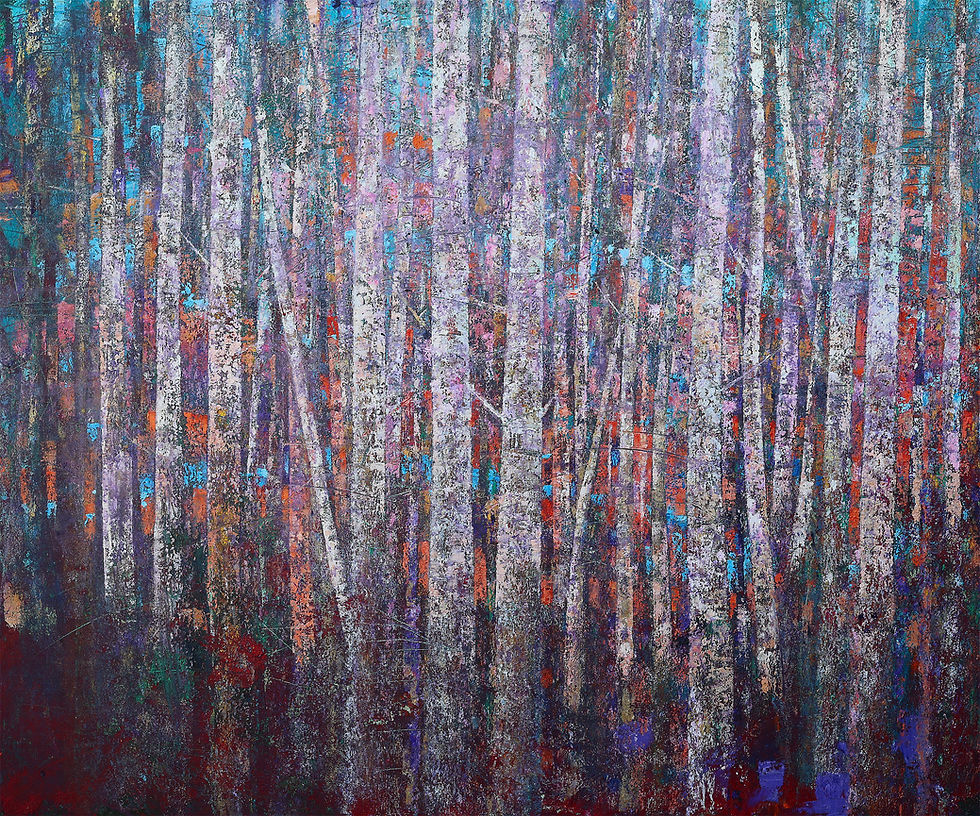
I always return to the forest as a subject for painting. It is a source of limitless fascination and inspiration. I create these forest paintings primarily from memory. I do have photographs taken at various locations, but I rarely use them to complete a painting. They may offer a starting point, a way of seeing, or a particular quality of light — but ultimately a painting has to work on its own terms. Effective paintings have a convincing internal character and consistency. I find I can only achieve this by moving beyond the constraints of the camera lens and allowing the natural rhythms of hand and eye to echo the cycles of growth and renewal. It has something to do with a sense of flow and movement at the heart of the forest.

The New Forest Residency
Many of the forest paintings in this body of work are the culmination of a two-week residency in the New Forest — a sustained period of time and space to work directly in response to a specific landscape. The experience of working intensively in one place over an extended period had a lasting influence on the work that followed.
Who Owns England? Painting a Stolen View
A little closer to home, I recently visited Thetford Forest with the intention of exploring the woods and gathering ideas for new work. I had been walking, enjoying the landscape and taking photographs, when I was confronted by a ranger who told me abruptly that I was on private land and had to leave immediately. There were no signs, no warnings, no barriers or fences. I had simply walked from a designated parking area into the forest for roughly 200 metres and was accused of trespassing. I was genuinely taken aback. The individual felt no obligation to explain why I should not be there — it was a simple statement of fact.
I returned home and did a little research. It turns out that half of England is owned by less than 1% of the population.
Guy Shrubsole, author of 'Who Owns England?', argues that the findings reveal a picture that has not changed for centuries. 'Most people remain unaware of quite how much land is owned by so few,' he writes. 'A few thousand dukes, baronets and country squires own far more land than all of middle England put together.'
"Land ownership in England is astonishingly unequal, heavily concentrated in the hands of a tiny elite." — The Guardian, April 2019

The Landscape as Contested Ground
You can explore relatively small areas of land designated for public use, or enjoy a view from a distance, but you cannot walk through or physically interact with vast swathes of the British countryside. It is a strange thought that the very earth under our feet generally belongs to someone else, and that our relationship with it is constrained by the laws of ownership. A person's land includes any trees, shrubs, hedges, plants and flowers, whether planted by the owner or having grown wild. Taking the concept of ownership to its limits, you could say that what I was doing was looking at a stolen view.
This encounter stayed with me. The painting that emerged from it is not a record of Thetford Forest but a response to the feeling of being excluded from it — of standing at a threshold that someone else controls. The forest in the painting is not quite accessible. It holds you at a distance, as forests sometimes do.


Comments