Zen and the Art of Cold Wax Painting
Updated: May 25
Many artists will tell you that painting is a constant struggle — a battle with materials and ideas. To make paint say what you want to communicate is a never-ending challenge; it requires commitment, resolution, and self-belief, and paradoxically, a measure of delusional thinking. The tortured artist, working against impossible odds to release an inner creative spirit, is the stuff of folk legend. If the objective of personal expression could be readily achieved, a single painting of outstanding brilliance and insight would suffice. That artists produce many paintings tells us that this key goal remains tantalisingly out of reach.
Life today seems difficult and troublesome, with an ever-present undercurrent of unease. The inner workings of the psyche are at the forefront of our engagement with the modern world, and few of us escape the gravitational pull of individual neuroses. The frenetic pace of life and our precarious economic condition have become the lived experience of far too many people.

The Personal Rewards of Painting
Painting — as with many other creative endeavours — offers genuine personal rewards. Can painting help us to be at one with the world? And does working with cold wax medium offer additional creative opportunities to calm the restless mind?
Painting can be complex and difficult. Whatever style you adopt, there are skills to learn and ideas to explore. All of this takes time, rehearsal, and commitment. But aligning the mind with practical engagement — connecting thoughts with physical actions and outcomes — is at the centre of a feeling of flow, leading to a state of calmness, acceptance, and well-being.
Part of the problem with modern life is the relegation of the physical to secondary or peripheral status. So much of what we do has been reduced to the press of a button or the swipe of fingertips across a glass surface. All-pervasive algorithms ensure we don't have to think for ourselves; decisions are made for us, and choice appears to multiply exponentially. In a sea of choice, we are left rudderless, without autonomy or direction.

The Physical Act of Making
With painting, the physical act of making is central to the creative activity and strengthens our sense of autonomy and agency. From the initial idea to a fully realised end product — a physical artefact shaped and manufactured to our own design — the artist is the sole creator responsible for all aspects of the completed work.
When we work with our hands, there is a conversation — a dialogue between hand, eye, and brain, a never-ending feedback loop. We learn with and through the exploration of material. Sometimes we need to take back control in a very personal sense.

Cold Wax and the Painted Surface
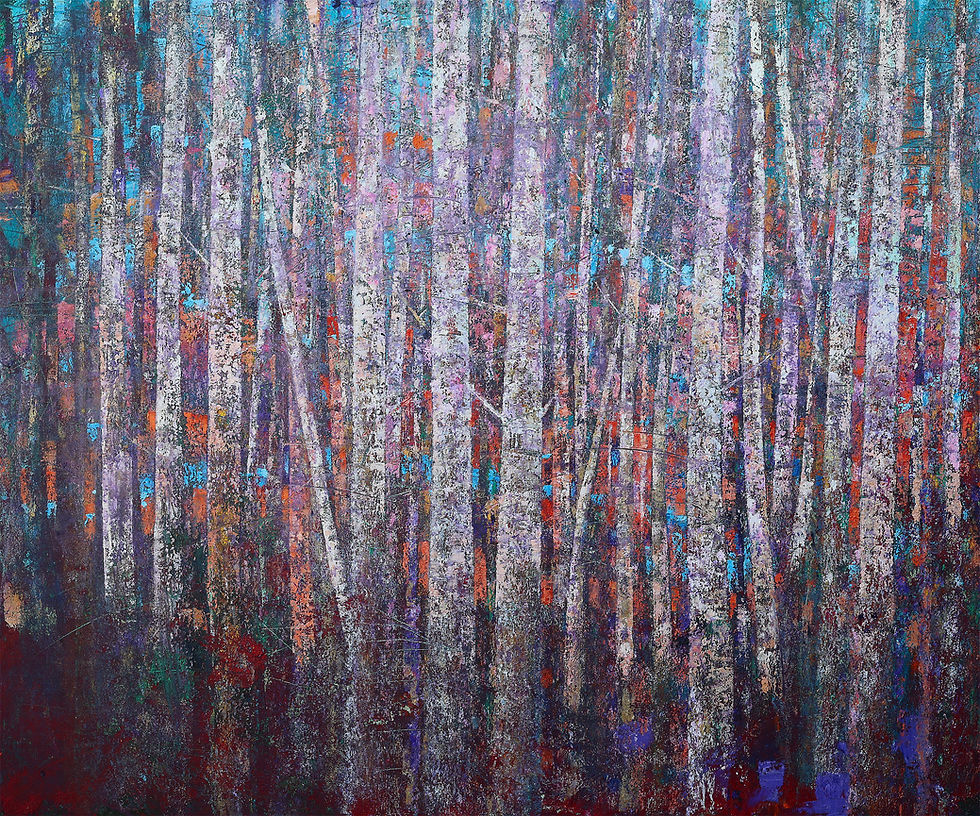
Why highlight the use of cold wax as an oil painting medium? All painting offers a combination of tactile and physical engagement — the deployment of shape, colour, form, and texture on a flat surface. The addition of cold wax medium amplifies and accentuates the physical qualities of oil paint. It encourages the exploration of raised surfaces, translucency, layers, impasto, and the rich sculptural possibilities of paint.
Cold wax supports a wide range of approaches, ideas, and compositions. It can be applied with sponges, brushes, rollers, palette knives, spatulas, tissue paper, crumpled cellophane, and card. It dries rapidly, allowing work to be executed swiftly. It is flexible and forgiving; there is no need to adhere to the traditional oil painting protocols of fat over lean, and the ratio of oil to medium is easily adjusted. Collage and unconventional materials can be embedded in the mix and bonded to the surface. As the medium dries and hardens it takes on the characteristics of clay and can be etched and scored with an assortment of tools. As the painting continues to dry it becomes matt, and the hardened surface can be selectively burnished to create a high-gloss finish.

Painting as a Meditative Experience
With the addition of cold wax, oil painting becomes multi-sensory, engaging all of our faculties. There is a genuinely meditative aspect to painting. In accepting the characteristics of oil combined with cold wax, and allowing the medium to follow its own path, unique marks and surfaces are generated. Keeping an open mind is vital, as inflexions and nuances are governed by the natural limitations and potential of the material.
Without the willingness to let go — to relinquish a level of control — the outcome may feel restricted and constrained. The wax medium cannot be manipulated with absolute precision, and neither should it be. With confident and open handling, with our attention directed towards the changes made with our hands, a painting can grow and develop as it responds to the synthesis of sight, thought, and touch.


Comments