Archaeology of Thought — Themes in Painting
Updated: Jun 12
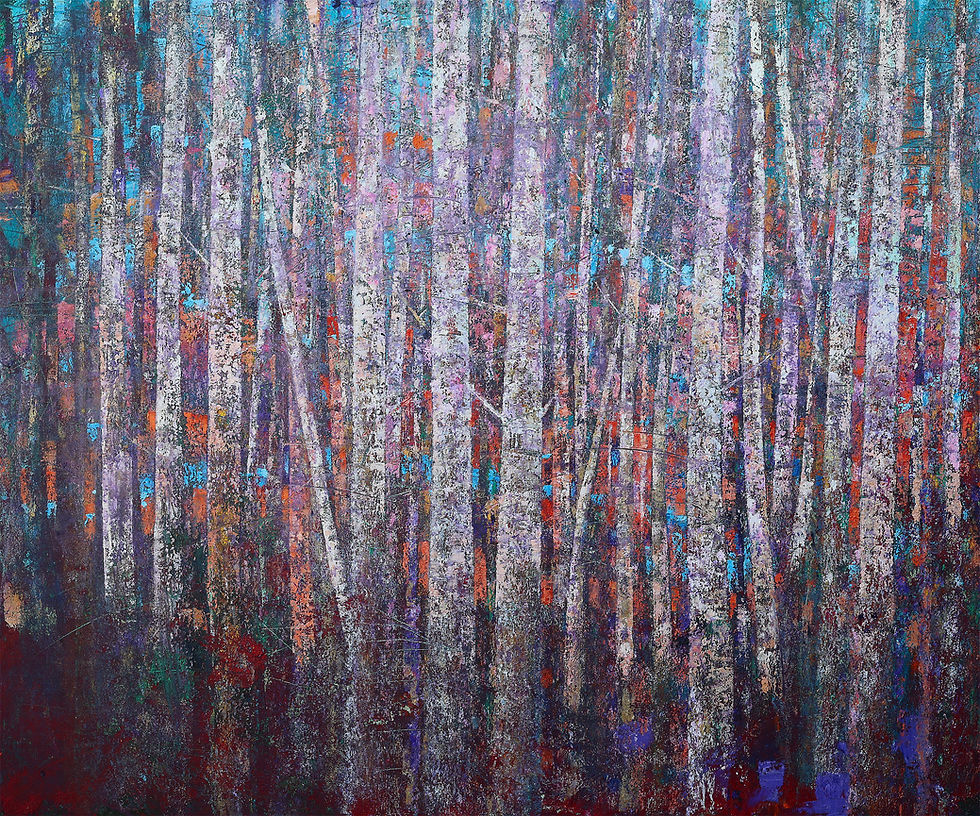
This painting, 'Archaeology of Thought', is made in oil and cold wax medium on a cradled wooden board. It belongs to a continuing body of work concerned with landscape, climate, and sensory experience translated into paint — work that asks what it means to record a place not through description but through accumulation.
The title is deliberate. Archaeology implies excavation: the careful removal of material to reveal what lies beneath. But it also implies the reverse — the slow deposit of layer upon layer over time, each stratum carrying the trace of what came before. Both movements are present in this work. The surface is built up and taken back, added to and erased, until what remains is not a record of a single moment but a compressed history of the painting's own making.

What Lies Beneath
The question that drives this series is not what a landscape looks like, but what it holds. The Cambridgeshire Fenlands — the landscape that most directly informs this work — are themselves a kind of archaeological site. The land was reclaimed from water over centuries of engineering effort, and it carries that history in its flatness, its drainage channels, its black peat soil. To paint this landscape is to engage with something that is always in the process of being recovered and lost simultaneously.
Cold wax medium is particularly suited to this kind of thinking. It dries to a matte, waxy surface that accepts subsequent layers without losing the evidence of what is underneath. Marks made early in the process remain visible — ghosted, altered, partially obscured — beneath the layers that follow. The painting becomes a record of its own history, a stratigraphy of decisions and revisions that mirrors the geological and cultural layering of the landscape itself.
The Conventions of Pictorial Space
Although 'Archaeology of Thought' is apparently devoid of objects, people, and scenery, the conventions of pictorial space exert a persistent gravitational pull. The eye reads the horizontal divisions as horizon lines, the tonal gradations as depth, the textured surface as ground. These readings are not imposed from outside — they arise from the way human perception is structured, from the deep familiarity of the upright body oriented towards a horizon.
This is what makes the work interesting to me: the painting does not depict a landscape, but it cannot escape being read as one. The conventions are inescapable. They operate below the level of conscious decision, in the same way that the accumulated knowledge and experience that the title refers to operates below the level of conscious thought — shaping perception, determining what we see and how we see it, without our being fully aware of the process.
Process and the Cold Wax Method
The cold wax process favours rapid execution and energetic marks. Paint is applied with palette knives, scrapers, and unconventional tools rather than brushes, enabling broad gestural movements across the surface. The wax medium extends the paint, increases translucency, and slows the drying time sufficiently to allow reworking — though it sets hard enough that subsequent layers can be applied without disturbing what is beneath.
The result is a surface that holds light differently from a conventional oil painting. The matte finish absorbs rather than reflects, and the depth of the layering creates a quality of internal luminosity — light that appears to come from within the painting rather than from its surface. This quality is central to the work's relationship with landscape: it is the quality of light seen through atmosphere, across distance, at the edge of visibility.


Comments