Cubism and the Contemporary Painter
Updated: Jun 12
I have always considered Cubism to be the key movement in the development of contemporary art — the ultimate catalyst, a clean break with tradition and a revolutionary way of seeing, interpreting, and reconstructing the material world through painting. After Cubism, there could be no return to the false comforts and certainties of representational painting. It fatally undermined conventional ways of recording what we see. For the first time, the supremacy of Renaissance perspective was critically challenged, and the notion of single-point perspective recognised as an artificial construct — no more than an artful solution, a tenuous connection to how we actually see and apprehend what is before our eyes.

Multiple Viewpoints and the Myth of Representation
Cubism informed us that we were not the centre of the universe, with rays of light travelling in predetermined straight lines from object to eye. On the contrary, we remain as we always have been — inconsequential and peripheral to the laws of science and physics, part of the endless flow of light across space and time, neither the final arbiters nor the final recipients. Cubism taught us that we are essentially stateless and without fixed status. The world is not static, and the concept of multiple viewpoints exploded the myth of illusionistic representation.
Einstein observed that 'Cubism put an end to the laziness or fatigue of vision. Seeing had again become an active process.' — Einstein, Die Kunst des 20. Jahrhunderts, 1931.

Cubism and the Landscape
For a painter working with landscape, the legacy of Cubism is felt not in the fragmentation of recognisable forms — though that remains one possibility — but in the freedom to treat the picture plane as a field of competing forces rather than a window onto a fixed scene. The landscape does not hold still. Light shifts, memory distorts, and the physical act of painting introduces its own logic. Cubism gave permission for all of this.
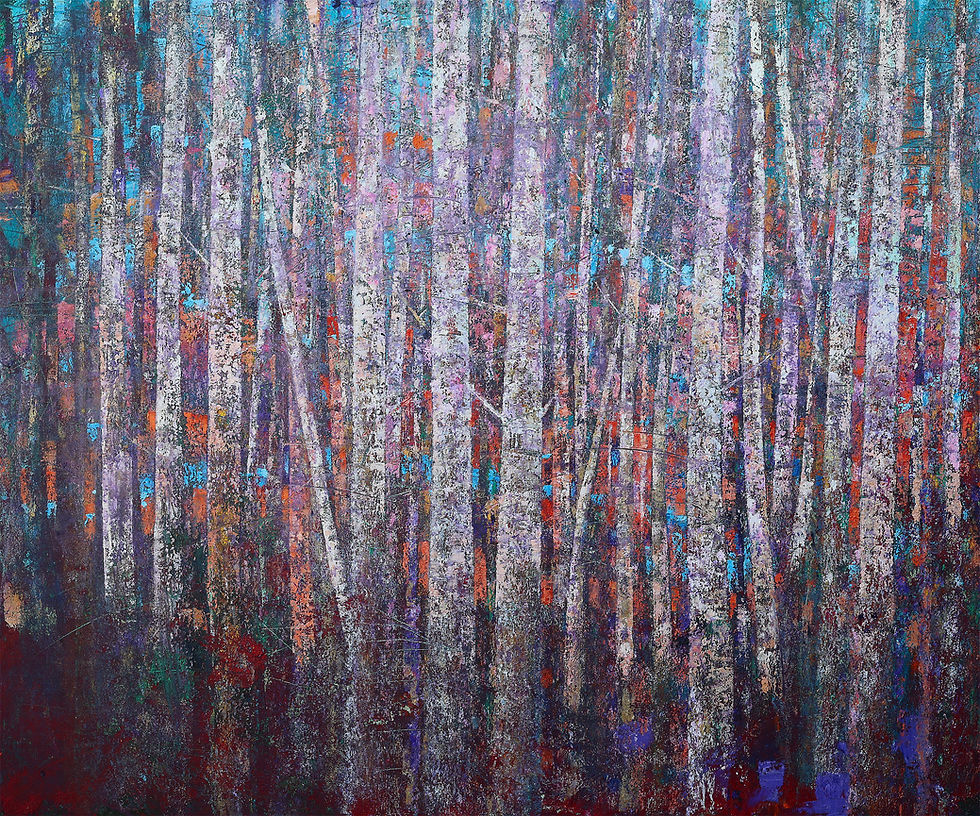
In my own work, the influence is less direct than structural. The vertical rhythms of trees, the layering of tones, the tension between flatness and depth — these are questions that Cubism opened up and that remain unresolved, productively so, in every painting I make.

Why Cubism Still Matters
The question of whether Cubism is at the core of contemporary painting is one I frequently revisit. It is not that every modern painter consciously draws on Braque or Picasso. Rather, the issues that Cubism raised — the instability of perspective, the artificiality of viewpoints, the gap between perception and understanding — remain unresolved. These challenges are still central to the practice of painting. In this sense, Cubism is not merely a historical movement; it is an ongoing condition that continues to shape how painters think and work.


Comments