'One Hundred Years of Solitude' — Forest, Painting and the Mystery of the Image
Updated: Jun 12
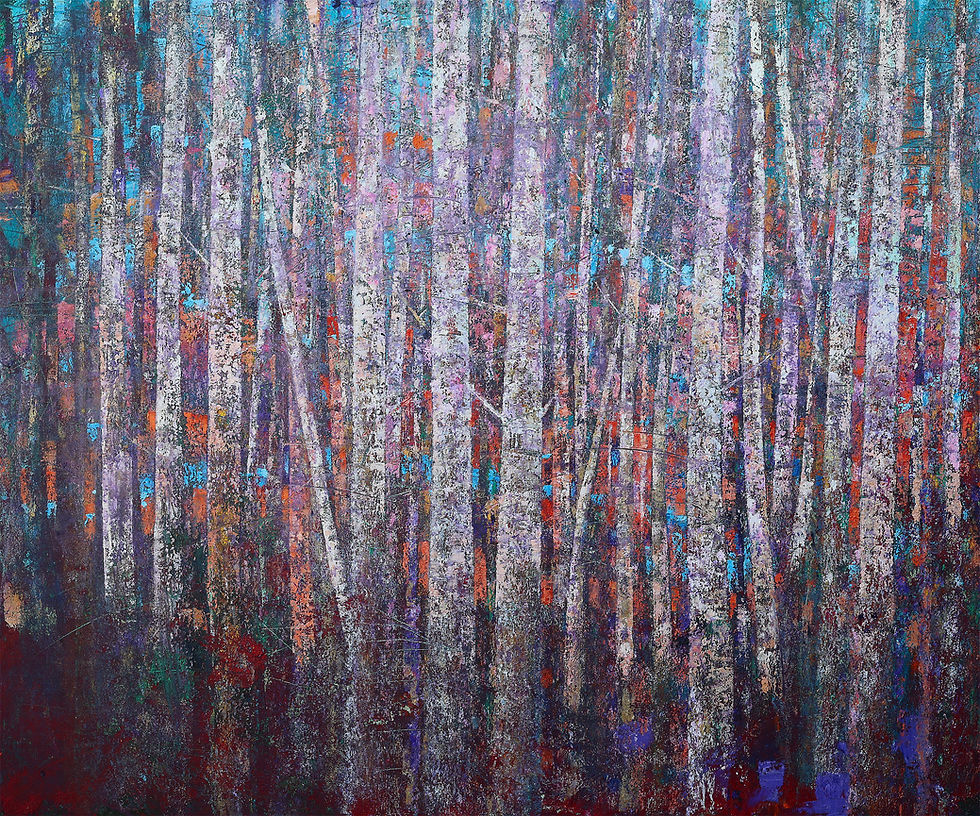
This painting takes its title from Gabriel García Márquez's celebrated novel. It is made in oil and cold wax medium on canvas, 150 × 100 × 3 cm, and its subject is a forest. René Magritte would say, with characteristic conviction, that this is not a forest. It is a series of marks and coloured pigment applied to a flat surface; the maximum depth of the paint, even where impasto is raised, is no greater than two millimetres.
And yet the forest is there. This is the enduring mystery of painting — one that no amount of art-historical knowledge or perceptual theory has come close to resolving. The conundrum at the heart of the painted image remains intact, regardless of how thoroughly it is analysed.

The Curious Persistence of Painting
Making pictures must qualify as one of the most curious and improbable forms of human activity. Painting has no obvious practical purpose; no one needs to paint or to own a painting in order to live a full life. Yet the impulse persists. Museums and public galleries attract larger audiences today than at any previous point in their history. The painted image continues to hold attention in a way that resists straightforward explanation.


Viewing Angle and the Limits of Illusion
Unlike the eyes of a painted portrait, which appear to follow the viewer as they move, the trees in this painting do not. Move away from the central viewing position and the narrow angle of compression renders the vertical forms unintelligible — they merge into one another and the illusion collapses. This is true of most representational painting. The spatial coherence of a depicted scene depends on the viewer occupying a fixed position: the illusion of depth, scale, and perspective is constructed for a single, static point of view.

Absence and the Alchemy of Paint
There are no tree trunks, branches, bark, dried grass, water, leaves, sky, clouds, or wind moving through the canopy. The scene is hermetically sealed. Everything tangible has been removed and substituted — and yet the alchemy of painting rushes in to fill the vacuum. The marks and tonal relationships that remain are sufficient to reconstruct the forest in the mind of the viewer.
This is the capacity that makes painting so difficult to account for: the ability of a flat, inert surface to generate the experience of space, atmosphere, and presence. The painter and the viewer collaborate in this act of reconstruction. Both parties temporarily suspend the distinction between what is real and what is imagined, inhabiting the painting simultaneously as makers and spectators. It is a form of shared perception — precise, unreliable, and entirely compelling.



Comments