Trees, Forests and the Recurring Motif — On Brian Cox and the Natural World
Updated: May 26
Watching Brian Cox's recent series, I found myself simultaneously enthralled, challenged, and perplexed by his account of the origins of the universe. I could more or less accommodate the critical role of gravitational force in the formation of galaxies and planetary systems — the notion of matter colliding and collapsing in on itself seemed theoretically plausible. But I found it difficult to connect that knowledge with the physical reality of Earth: forests, grasslands, sky, and sea. The fundamental chemical structure of matter at the heart of everything we can apprehend with our senses reduces us to mere flotsam in the flow of time.

Why Trees
Trees and forests have been the focus of my painting for some time, and I think I am beginning to understand why. Trees were among the first plants to colonise the land, approximately 430 million years ago in the Silurian Period, long before vertebrates made the same transition. There is something in that deep temporal precedence that I find compelling.
Recently, taking a short break on a long bike ride, I sat on a bench opposite a horse chestnut tree in the village of Little Downham. It was not remarkable in any obvious sense — it looked like all the other trees of its type — but I found myself momentarily transfixed. As I continued to look at this object, anchored in the ground, the twisting shapes of the trunk, the branches subdividing, and a myriad of leaves in autumn free fall, I registered the idea of a tree as if for the first time. A beautiful, elegant structure — and simultaneously a collection of chemicals and atomic particles arranged in a configuration we have labelled 'tree'. I find myself questioning the assumption that we alone are sentient, the sole proprietors of conscious thought. Just like us, trees are contained within a finite allocation of time. Unlike many of our species, this particular tree embodied dignity, purpose, and silent resolve.

The Thetford Forest Painting
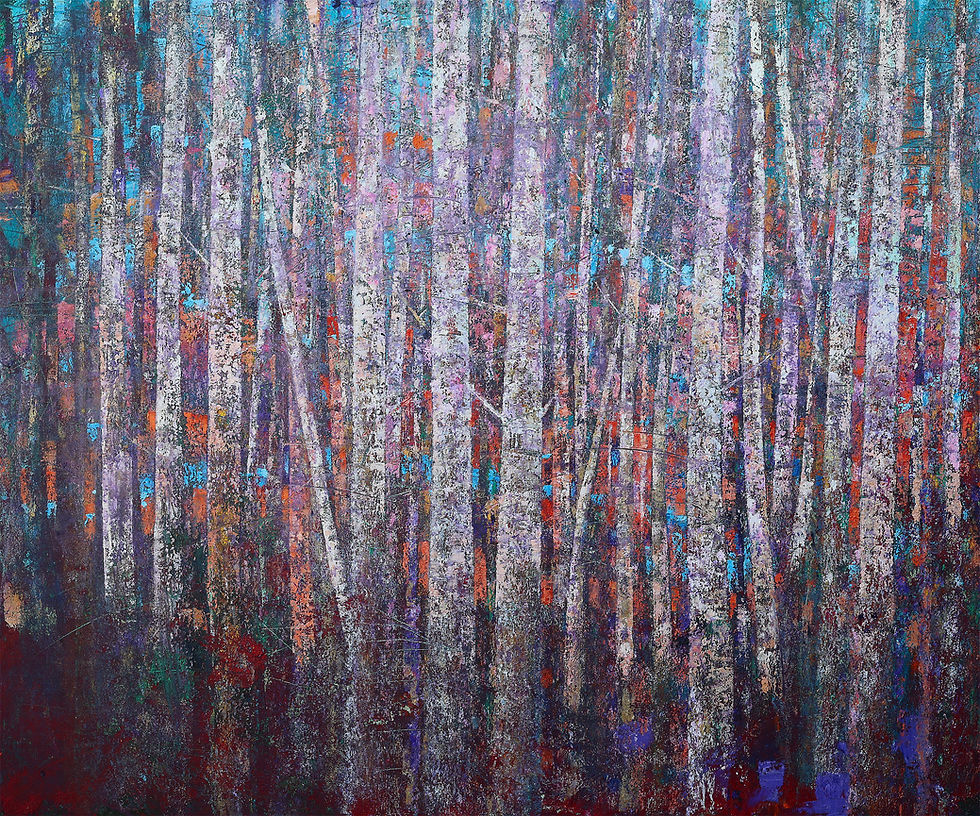
The large-scale work based on Thetford Forest shown here remains unfinished at the time of writing. It has already followed a meandering pathway through various twentieth-century painting styles. There are elements of Impressionism and perhaps a suggestion of Seurat's pointillism, but the work of Boccioni — a member of the Italian Futurist group — is currently the strongest influence. Uppermost in my thinking has been the creation of a sense of movement and flickering light, with forms dissolving and reforming across the surface.
I have experimented with a range of techniques, including blurring, repetition, and the use of lines of force. The panoramic composition encourages the eye to move across the picture plane from side to side, reinforcing the sense of continuous, restless energy that I associate with the forest as a subject.

Related Posts


Comments