The Space Between Painting and Sculpture
Updated: Jun 12
Creating a convincing sense of the third dimension in painting is one of the medium's enduring challenges. There are many ways to render depth and recession — through perspective, tonal gradation, atmospheric colour — but some painters have pursued a more direct solution: the physical projection of paint beyond the picture plane into actual space.
Van Gogh, Willem de Kooning, Frank Auerbach, and Anselm Kiefer are all painters known for the palpable, tactile presence of their surfaces. In Kiefer's work in particular, the density of material applied to the canvas moves beyond the conventions of painting altogether. The accumulated layers of paint, lead, straw, ash, and found objects project from the surface and occupy the realm of low relief sculpture. By attaching real objects to the work, Kiefer breaks the boundary between painterly illusion and physical reality — the painting becomes an object in the world rather than a window onto it.


'A Warmer Latitude' — Materials and Process
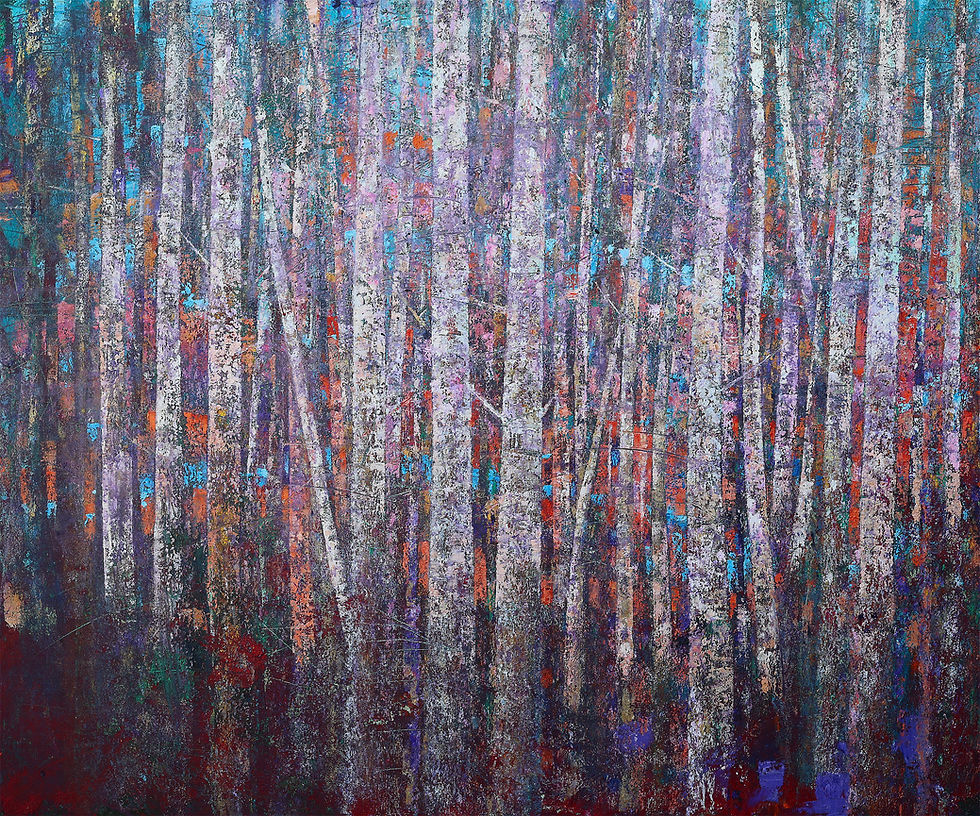
This painting uses a combination of bitumen, plaster, oil paint, and cold wax medium. It has undergone many changes and is virtually unrecognisable from its earliest layers. In the initial stages, plaster was applied thickly and, before it dried, etched with an assortment of knives and sharp tools. Bitumen, diluted with turpentine, was used to stain the surface and strengthen the tonal contrast between raised edges and deeper marks. The foreground was modelled in oil paint applied directly from the tube.
In later stages, a heat gun was used to meld the wax with the oil, introducing new and unexpected textures and tonal qualities that are not readily achievable through conventional painting techniques. The heat causes the wax to flow and pool, creating surface effects that are partly controlled and partly the result of the material's own behaviour under heat — a quality of productive unpredictability that is central to the work.

Ceramics and the Influence of Clay
Training in ceramics has had a lasting influence on the way I approach paint. Clay is a remarkable material for its ability to record a vast range of marks and impressions, and the effects achievable through the interaction of oxides and stoneware glazes can be extraordinary. The intense heat of the kiln introduces an element of chance that is both the risk and the reward of the process — without it, a piece can easily settle into predictable conformity.
There is a direct parallel with the use of a heat gun in painting. Both involve the application of heat to a material that responds in ways that cannot be entirely anticipated or controlled. The painter, like the ceramicist, must learn to work with the material's own tendencies rather than against them — to recognise the moment when an unexpected result is better than the intended one, and to have the confidence to leave it.
In this sense, the space between painting and sculpture is not simply a matter of physical relief or the attachment of objects. It is a question of how the painter relates to material: whether paint is treated as a medium for depicting something else, or as a substance with its own physical properties, its own behaviour, its own capacity to surprise.


Comments