How Long Does It Take to Create a Painting? Fifty Hours or Fifty Years?
Updated: May 31
Artists are often asked this question — it is typically the first and frequently the last. The conventional answer is that the hours spent directly on the painting might add up to a few days, weeks, or perhaps a month or two. The artist would then wisely note that, in reality, the piece in question represents the accumulated knowledge and experience of a lifetime. Both answers are true, and neither is complete.

The Influence of Photography
My early work was more geometric, drawing inspiration from the Futurist painting techniques of Boccioni and Severini — colours divided into directional marks and sequences of shapes. Upon reflection, this approach felt constrained, and I shifted towards a more impressionistic style, more responsive to the observed world.
The photographic image has an enticing quality. Most painters soon understand, however, that images produced by machines are also artificial and misleading — they function within specific optical, mechanical, and chemical constraints. Some exceptionally creative painters can transcend these limitations, working by improvising with focal points, depth of field, cropping, perspective, and resolution. Photo-realists, by contrast, replicate the photograph completely, centimetre by centimetre, showcasing impressive technique and hand-eye coordination. Both approaches are legitimate; neither is the whole story.

The Open-Ended Approach
A key advantage of an open-ended approach to painting is how initial possibilities and explorations can become essential elements of the final piece. The knowledge accumulated over time influences how you approach a particular subject — the experience of previous paintings, the understanding of materials, the accumulated sense of what works and what does not. All of this is present in the painting, even when it is invisible.

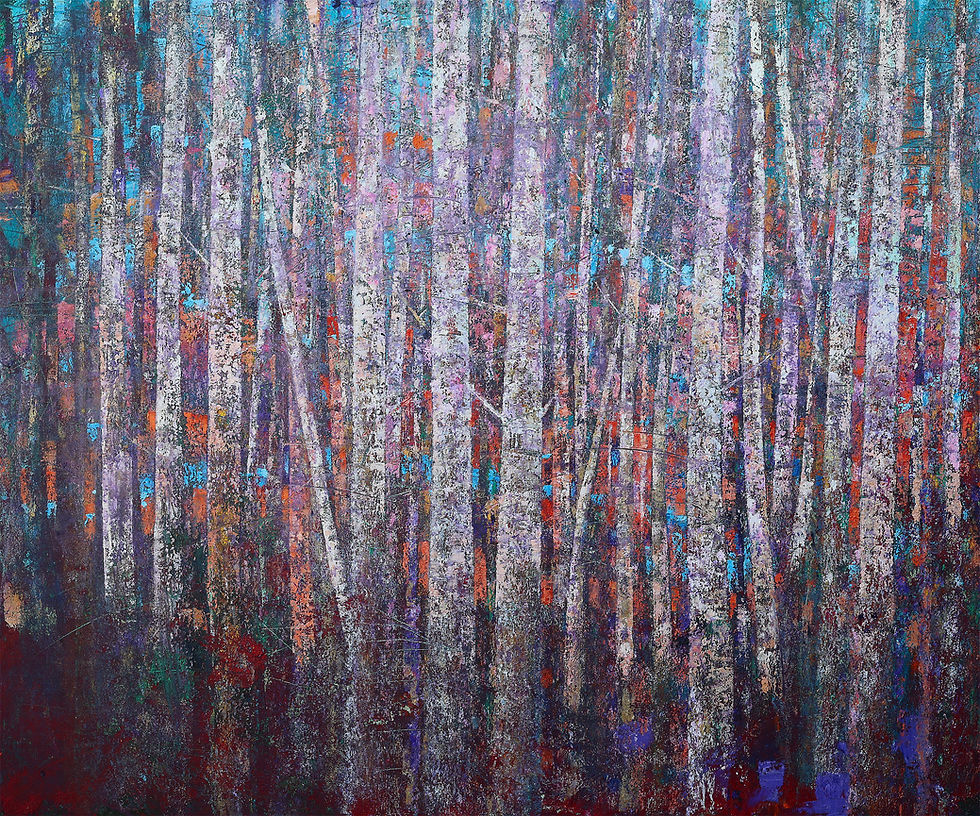
'The Lie of the Land'
In 'The Lie of the Land', a thick layer of paint combined with cold wax medium creates a raised, highly textured surface that seems to resist subsequent paint layers. While this might appear to be a significant problem, it seldom is — in fact, the opposite is often true. A surface that does not immediately yield to the painter's intentions creates productive resistance, forcing decisions that a more compliant surface would not demand.
Understanding that a false start can eventually lead to more creative opportunities is one of the harder lessons of painting. The drawback of this indirect approach is realising that it rarely proceeds in a straight line — and that the detours are often where the most interesting work happens.

Fifty Hours or Fifty Years?
How long does it take to complete a painting? It could be a few days or weeks when considering the time actively spent at the canvas. But it may take several years — or more — when factoring in the knowledge, understanding, skills, and life experiences required to bring it into being. The painting on the wall represents both: the hours of direct labour, and the decades of accumulated seeing.



Comments