Materials, Tools and the Unconventional: 'Shallow Lands'
Updated: Jun 12

Paint can be applied with almost anything that will hold it. I rarely use brushes in my current work — not from any aversion to them, but because working with brushes alone tends to return me to a familiar repertoire of marks and painterly qualities that become predictable over time. The introduction of unconventional materials and tools has been both liberating and demanding, opening up surface possibilities that a brush simply cannot produce.

'Shallow Lands' — Materials and Process
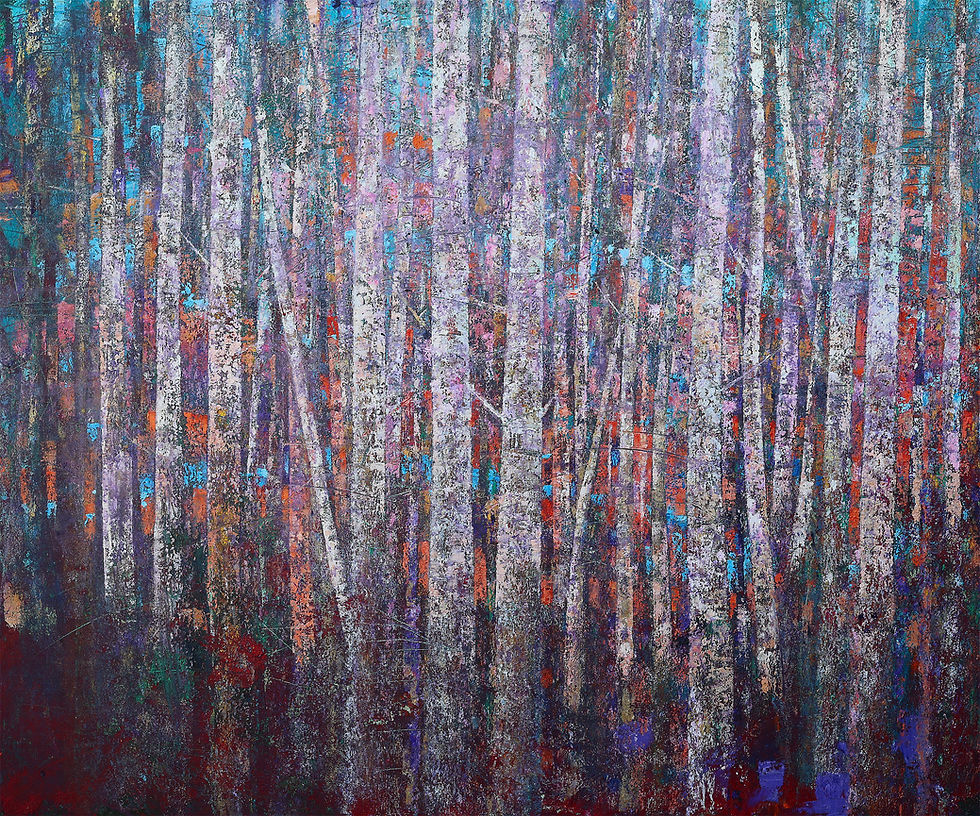
Embedded within this painting are cold wax medium, oil paint, bitumen, pumice stone, enamel, earth, and tissue paper. At one stage it also included dried seed heads, but these were removed because they undermined the fragile illusion of space and perspective that the composition depends upon. I describe my working method as a process of accretion — the slow build-up of successive layers — and the surface of this painting carries the evidence of that accumulation.


Sequence and Revision
The first layers are established with rollers and brayers, enabling broad areas of the canvas to be blocked in quickly. After that, any strict sequence or logical progression tends to break down. Different materials are applied in different orders, partly to see what happens, and partly because the surface itself begins to suggest what it needs. I am constantly looking for unexpected combinations and interactions between surfaces — hence the ongoing revision, scraping, sanding, and burning that characterise the process.
The tools in use at any given point include palette knives, orbital sanders, heat guns, scrapers, sticks, crumpled paper, cellophane, and corrugated card. The process is physically demanding and materially unpredictable, which is precisely what makes it productive.

Composition and the Fenland
The composition reduces landscape to its basic elements: earth, sky, and horizon, with minimal embellishment. A central vanishing point establishes a clear reference to aerial and linear perspective. The title confirms both the topography of the Fenland location and the relief modelling of the surface. This is a land that exists, for the moment at least, below sea level — a landscape defined by its flatness, its exposure, and the particular quality of light that moves across it.

Related Posts


Comments